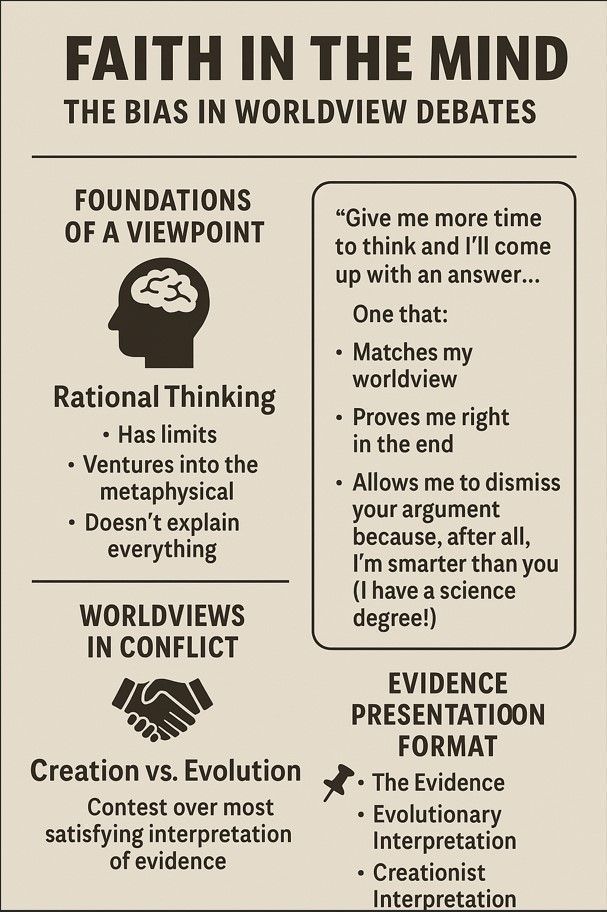
🧠 Faith in the Mind: The Bias in Worldview Debates
🎭 Setting the Stage
There’s a curious pattern that emerges in discussions about origins and worldviews. It often goes something like this:
“Give me more time to think and I’ll come up with an answer…
One that:
Matches my worldview
Proves me right in the end
Allows me to dismiss your argument because, after all, I’m smarter than you (I have a science degree!)”
This mindset isn’t unique to one side—it’s a universal human tendency. And at its core, every worldview is faith-based, whether it claims scientific authority or theological grounding.
🧱 Foundations of a Viewpoint
🎓 The Fear of Being Wrong
Educated or not, people rarely want to believe they’ve missed the mark by a wide margin. It’s even more uncomfortable when their reputation or career depends on being “right.”
Why people resist opposing views:
-
They’ve invested time, energy, and identity in their worldview.
-
Admitting error could lead to a personal or professional crisis.
-
It challenges their place in the world and their understanding of it.
Rethinking one’s conclusions is painful—but sometimes necessary.
🧭 Rational Thinking: A Tool with Limits
🧠 Rational ≠ Infallible
Being rational is good. In fact, it's a quality tied to scientific thinking, requiring:
-
Patience
-
Evidence-based reasoning
-
Analytical observation
But rationality has its limits—especially when facing deep questions like the origin of the universe.
Some things science can’t fully explain:
-
The origin of matter, space, and time
-
Consciousness and morality
-
The why behind natural laws
So no, rational thinking isn’t wrong—but it can’t explain everything, especially when we venture into the metaphysical.
⚖️ Worldviews in Conflict: Creation vs. Evolution
🤝 It’s Not Just Science—It’s a Debate of Belief Systems
Phrases like “there is no right or wrong answer” frustrate people on both sides of the argument. Neither side is content with ambiguity. Thus, the Creation vs. Evolution debate becomes a contest—a challenge to see who provides the most satisfying interpretation of the evidence.
“Let the best interpretation win.”
To bring structure and clarity, the following layout will be used:
📚 Evidence Presentation Format
We’ll present:
-
The Evidence
-
The Evolutionary Interpretation
-
The Creationist Interpretation
Let’s examine each exhibit side by side.
📌 Exhibit 1: The Tree of Life
🌳 The Evidence
Different animals resemble each other. When categorized, their similarities form branches—a “tree of life” where closer organisms are grouped, and more distant ones are placed farther apart.
-
Group Example 1: Horses, zebras, and donkeys
-
Group Example 2: Lions, tigers, and house cats
-
Unrelated Group: Dogs and jellyfish
🧬 Evolutionary View: Common Descent
The idea that all life originated from a single common ancestor. The fossil record is cited as support, with examples like:
-
The progression of horses over time
-
The evolution of whales from land mammals
🚨 Problems with this interpretation:
-
Assumes that all fossils are part of a generational lineage.
-
Uses physical similarity as the sole indicator of ancestry.
-
Makes presumptive conclusions (e.g., “big horses evolved from small horses”) without solid supporting evidence.
If the earth were destroyed today and rediscovered, would scientists assume large horses evolved from small horses just by size?
✝️ Creationist View: Design, Not Descent
The “tree of life” is a construct of the imagination, not observed in nature.
Key Creationist Points:
-
Similarities may reflect a common designer, not common ancestry.
-
The differences between species are more important than the similarities.
-
No fossil has ever been observed transforming into another kind.
“Variation within kinds” is expected, but new kinds from old kinds has never been observed.
🧩 Final Thoughts: Let the Evidence Speak
This approach doesn’t aim to shut down debate—but to frame it fairly. Both sides claim to interpret the same evidence, but from very different worldviews.
Key Takeaways:
-
Everyone operates from a faith-based worldview, whether theistic or secular.
-
Rational thinking is useful, but not all-encompassing.
-
The #Creation vs. #Evolution debate deserves fair hearing, structured dialogue, and honest interpretation.