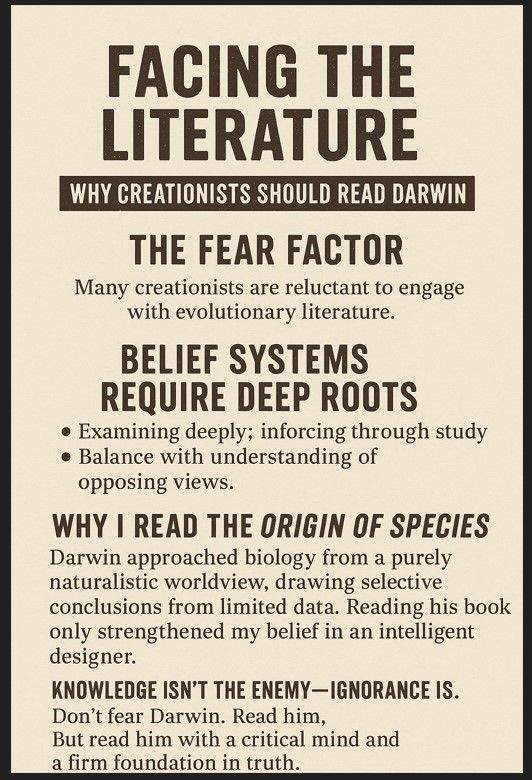
📖 Facing the Literature: Why Creationists Should Read Darwin
😨 The Fear Factor: Why Some Avoid Evolutionary Texts
Many creationists are hesitant—even afraid—to read evolutionary literature. Whether it’s scientific journals, textbooks, or foundational works like The Origin of Species by Charles Darwin, there's often a reluctance to engage with the opposing worldview.
Common reasons for avoiding evolutionary writings:
-
Fear of being intellectually swayed
-
Concern about shaking their faith
-
Assumption that the material is entirely deceptive
-
Lack of confidence in being able to refute the arguments
At the root of many of these concerns is what we can call a “fear factor.”
🌱 Belief Systems Require Deep Roots
Being confident in your worldview—whether creationist, theistic, or naturalist—takes more than surface-level faith. It requires being rooted, studied, and prepared.
If your beliefs are not:
-
Examined deeply, they can be shaken by new information.
-
Reinforced through study, they may not withstand scrutiny.
-
Balanced with understanding of opposing views, they can become narrow and reactionary.
“Faith that’s never challenged may not be faith at all—it might just be convenience.”
📘 Why I Read The Origin of Species (And Why You Should Too)
I personally encourage anyone—especially believers—to read Darwin's book. Not to convert you, but to strengthen your position through understanding.
What I discovered:
-
Darwin approached biology from a purely naturalistic worldview.
-
His reasoning was based on limited data available during the 19th century.
-
He made selective use of facts, ignoring or downplaying those that didn’t fit.
-
His conclusions today are often at odds with modern biology.
Reading The Origin of Species didn't weaken my faith—it strengthened it.
🔬 Modern Biology vs. Darwin’s Assumptions
Science has come a long way since Darwin’s time. With the advent of molecular biology, genetics, and information theory, we now know far more about how life functions—and where Darwin went wrong.
Key areas where Darwin was “off the mark”:
-
Cell complexity: He didn’t understand DNA, proteins, or how intricate cells truly are.
-
Inheritance mechanisms: He had no knowledge of genes or how traits are passed on.
-
Species origin: He speculated, but never observed, new species being created from old ones.
-
Fossil record: His prediction of gradualism isn’t supported by the sudden appearance of life forms in the fossil record.
With today's understanding, Darwin’s explanations often read more like imaginative storytelling than scientific observation.
🧠 Knowledge Isn’t the Enemy—Ignorance Is
Avoiding opposing views out of fear is not a sign of strength—it’s a sign of insecurity.
Instead:
-
Be willing to engage with different ideas.
-
Read what opponents actually say, not what others say about them.
-
Test your worldview against real challenges—not straw men.
This is how we grow—not just in faith, but in understanding, wisdom, and confidence.
🧭 Final Thought: Read to Refine, Not Redefine
Don’t fear Darwin. Read him.
But read him with a critical mind and a firm foundation in truth. You might come away more convinced than ever that design, intelligence, and purpose are behind everything we see in nature.