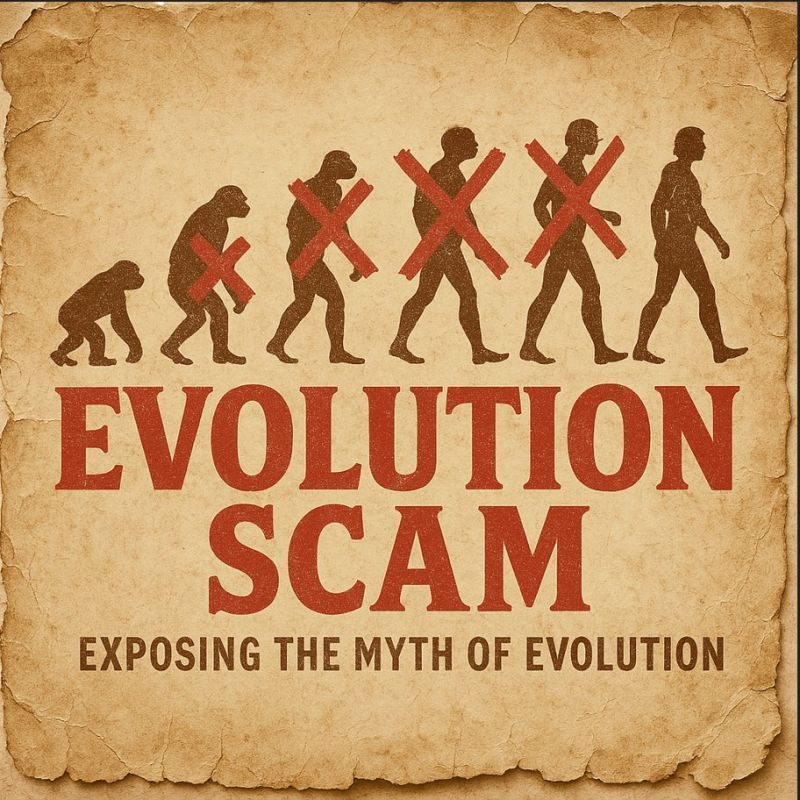
Why museum mannequins and slippery definitions keep propping up a broken evolutionary story
Summary (TL;DR):
-
Museum reconstructions of “Lucy” (Australopithecus) often show human-like feet and knees—a portrayal refuted by newer anatomical data indicating ape-style hands-for-feet. The display sells a story that the bones don’t actually prove.
-
The word “hominid” bakes evolution into the definition. If you sort the fossils without the story, the “ape-like” ones are apes and the “human-like” ones are humans—leaving the “hominid” bucket empty.
-
Neanderthals were human—they buried their dead, made complex tools, used pigments/jewelry, made music, lived in family groups, and intermarried with other humans. The only other possibility is that they were Nephilim as the Scriptures stated.
-
The popular old-earth notion of “soulless hominids” (pre-Adam bipedal tool-makers without the image of God) creates theological contradictions (death before sin; bestiality implications) and historical gaps (where are the eons of graves and artifacts?).
-
A better fit for Scripture and the data: post-Flood humanity dispersing during the Ice Age, with Neanderthals representing an early people group—not pre-human animals.
1) What the museum won’t tell you about “Lucy”
When you meet Lucy under the museum lights, she’s usually standing upright with forward-facing human knees and human-looking feet. That’s a paleo-artist’s decision, not a bone-level proof. As research progressed, the “human feet” claim collapsed: australopithecines show ape-type, grasping feet (think “hands for feet”) and out-angled knees typical of apes.
Bottom line: The exhibit’s pose smuggles in the conclusion—humanization by mannequin—instead of letting the anatomy speak.
If you remove the artwork and keep the bones, Lucy looks like what she is: an ape.
2) The “hominid” label is a trick of definition
“Hominid” gets used as a sweeping ape-to-man category. But notice what happens if you sort finds by features actually in the bones rather than the story attached to them:
-
Clearly ape traits? → Apes
-
Clearly human traits? → Humans
Do that consistently and the in-between “hominid” bucket drains out. The category depends on evolutionary assumptions, not on unambiguous transitional anatomy.
3) Neanderthals: people—full stop
Even many evolutionists now admit Neanderthals were human. Why?
-
Burials (intentional, family clusters)
-
Complex tools, adhesives, fire use
-
Pigments, ornaments/jewelry, personal adornment
-
Evidence of music (bone flute claims)
-
Care for the infirm, community life
-
Intermarriage with other humans (genetic continuity)
That’s image-of-God behavior: language, planning, aesthetics, covenantal bonds, and honoring the dead. Different skull shapes? Humans today also vary widely. Variety ≠ evolutionary ladder.
4) The “soulless hominid” detour (and why it breaks)
Some old-earth creationists try to keep deep time by proposing long ages filled with bipedal, tool-using, burial-practicing “non-humans”—then God later “ensouls” a pair (Adam & Eve). This fix creates bigger problems than it solves:
Theological problems
-
Death before sin: If “soulless hominids” lived and died for eons, death isn’t the wage of Adam’s sin (Rom. 6:23); it’s just “how nature works.” That undercuts the Gospel logic (why Christ dies to conquer death).
-
Bestiality implication: If Adam’s descendants “interbred” with these non-human beings, the model brushes against forbidden boundaries Scripture draws between man and beast.
Historical/data problems
-
Where’s the mountain of remains? Eons of “soulless hominids” should leave vast cemeteries and cultural layers. We don’t see them. The scale of evidence fits a post-Flood, post-Babel world, not deep pre-Adam ages.
-
Moving goalposts: Calling Neanderthal culture “not truly human” becomes a No True Scotsman fallacy—whenever human behaviors show up, the bar is raised again.
5) The Flood–Ice Age timeline fits what we find
A Scripture-first timeline puts the global Flood ~4,500 years ago, followed by a centuries-long Ice Age. As seas stabilized and forests regrew, early post-Flood peoples pioneered harsh margins (like Ice-Age Europe). Neanderthals fit as an early European people group—robust, resourceful, fully human—whose distinct features spread and blended through intermarriage as populations mixed.
6) Why the intimidation works—and how to beat it
The pressure doesn’t come from bones; it comes from storytelling—textbooks, docuseries, and life-sized models that humanize apes and de-humanize humans. When you read the technical literature, experts routinely disagree about the same fossils (ape vs. human; ancestor vs. side branch). That’s not “settled science”; that’s contested interpretation.
Action step:
-
Separate art from anatomy.
-
Separate definitions from data.
-
Sort fossils by what they are (ape or human), not by the story they’re drafted to serve.
7) The simple, coherent alternative
-
God created mankind in His image—from the start (Gen. 1:26–27).
-
Death enters through Adam’s sin, not before (Rom. 5:12).
-
All post-Flood peoples (including Neanderthals) are fully human—descendants of Noah—diverse in form and culture, yet one race (Acts 17:26).
-
The Gospel’s logic stands: if death came by sin, life comes by the risen Messiah.
Share this if you’re tired of mannequin science
If you’ve ever felt “talked into” evolution by a bronze statue with glass eyes and perfect teeth, you’re not alone. The cure is simple: read the bones, not the billboard—and let Scripture set the frame.
Filed under: Fossil Fables, Museum Myths, Human Origins