-
🧬 Vestigial Organs: Science, Assumptions, or Science Fiction?
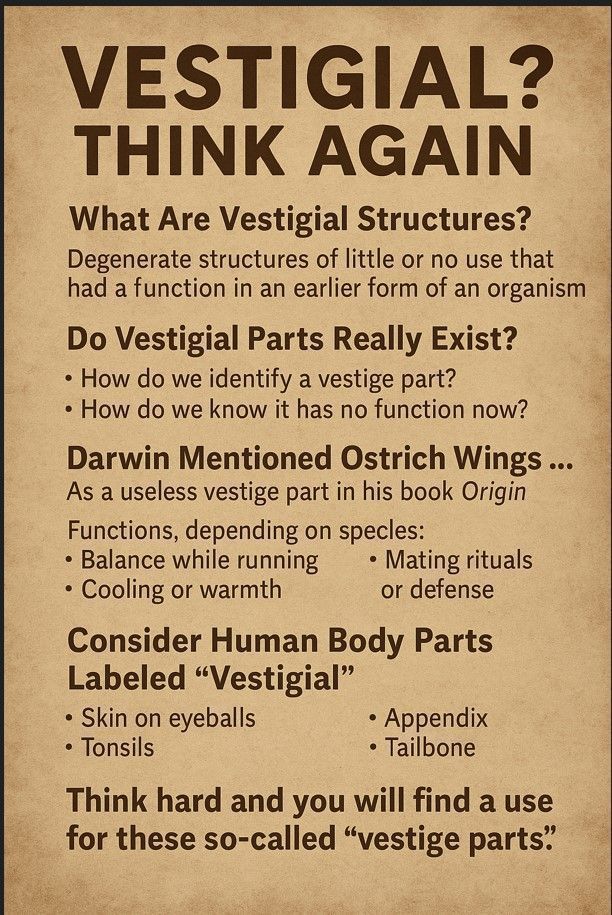
What Are Vestigial Parts?
In biology, a vestigial structure is traditionally defined as:
"A degenerate or imperfectly developed organ or structure that has little or no utility, but that in an earlier stage of the organism—or its evolutionary history—performed a useful function."
This idea forms part of the backbone of evolutionary theory. But does it really hold up under scrutiny?
❓ Questions Worth Asking About Vestigial Structures
Let’s challenge this idea by asking a few honest questions:
-
Do vestigial parts truly exist in nature?
-
How are they identified as vestigial?
-
Have we ever observed a vestigial part being fully eliminated from a population over time?
-
How do we know the so-called vestigial part doesn’t actually serve a purpose—maybe even a critical one—for the organism today?
-
Could it be that the feature is becoming more functional rather than less, fitting into the natural selection model in the opposite direction?
These questions deserve real answers—not assumptions dressed as facts.
Darwin and the Ostrich: A Case Study in Assumption
In The Origin of Species, Charles Darwin famously points to ostrich wings as an example of a vestigial structure—essentially labeling them useless because the bird doesn’t fly.
But is flight the only function a wing can serve?
What Darwin Missed
If Darwin had looked more closely at the behavior and biology of flightless birds, he may have avoided a serious oversight.
Real Functions of Ostrich Wings:
-
Balance while running at high speeds
-
Cooling system in hot climates
-
Warming in cold temperatures
-
Ribcage protection during falls
-
Courtship displays during mating rituals
-
Threat display to scare predators (as seen in emus)
-
Sheltering chicks from harsh weather or predators
If the wings are “useless,” then why do they contain functional muscles and play active roles in survival?
🧠 The Evolutionist Response: Still Clinging to the Vestige
Despite modern observations and biological functions being clearly documented, many evolutionary websites and encyclopedias—like TalkOrigins.org and Wikipedia—continue to classify ostrich wings as vestigial.
But consider this:
-
Evolutionists say ostriches "lost" the ability to fly...
-
But even by their own fossil record, ostriches were never shown to fly in the first place!
That’s not science. That’s speculation.
🕰️ A Timeline That Doesn’t Add Up
According to evolutionary sources:
-
Ostriches supposedly evolved 55–40 million years ago.
-
Humans supposedly evolved only 5–7 million years ago.
If evolution is supposed to improve species over time, why are ostriches still considered to be in a “transitional” stage—even after 50 million years more evolutionary time than humans?
Something doesn’t add up.
🔍 Re-Examining the Opening Questions
Let’s go back and answer the questions we posed at the beginning:
❓ Do vestigial parts really exist?
-
Not according to what we’ve observed. So-called “vestiges” often serve important functions.
❓ How can we identify a vestigial part?
-
That’s the problem. There's no consistent, scientific method. It's often based on assumptions, not evidence.
❓ Has a vestigial part ever been observed being eliminated for the sake of natural selection?
-
No. We’ve yet to see a part disappear in real time with a measurable evolutionary advantage.
❓ Can an ostrich do without its wings?
-
Let’s be honest... absolutely not. Their wings serve real, observable purposes.
🗒️ The “Vestige” List: Are These Parts Really Useless?
Evolutionary scientists often list several human organs as vestigial:
-
Skin on the eyeballs
-
Tonsils
-
Appendix
-
Tailbone (coccyx)
-
And many more…
By that logic, we might as well add:
-
Arms and legs (you can technically live without them)
-
Ears (plenty of deaf people function)
-
Nose (you can breathe through your mouth, right?)
Would you volunteer to cut off these “useless” parts? I didn’t think so.
🤯 A Thought to Ponder
Many features labeled “vestigial” are only called so because science doesn’t fully understand them yet.
The truth is:
Ignorance of function does not equal absence of function.If we really stop and think, we often discover how intricately designed and purposeful these features are—no matter how small or obscure.
🧭 Conclusion: Think Before You Chop!
-
The term “vestigial” often assumes what it should be proving.
-
Lack of knowledge about a structure's function does not make it useless.
-
Darwin’s conclusions were often based on limited understanding, not evidence.
-
The design and functionality of biological features point to purpose, not accident.
So before we label something a leftover of evolution, let’s use the brains we were given—and think a little harder.
-
Vestige Parts
Post Metadata
Author: Anonymous
Published on: 2010-05-02 11:53:51
Last updated on: 2025-04-13 11:47:47